
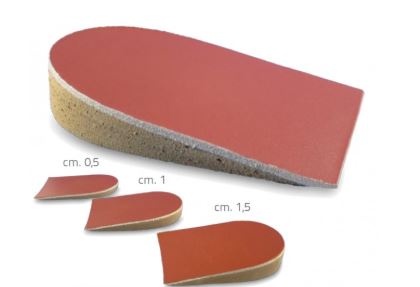
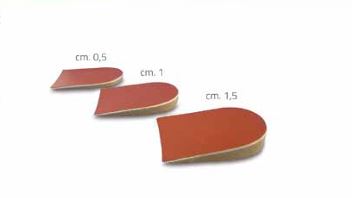
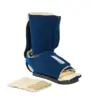
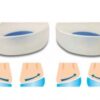
Heel Raise Wedges in 3 Heights: 0.5 cm, 1 cm & 1.5 cm
These heel wedges are orthotic inserts that can be placed inside the footwear.
The surface of the each wedge is covered with leather on the side that is in contact with the foot. The actual material is made of synthetic cork and the bottom part has an adhesive strip to help with the positioning.
Heel Raise Wedges have many uses:
- Help to relieve pressure on the heel, thus relieve pain
- Reduce the tendency of the foot to roll inward
- Help with structional and functional foot imbalances
- For lifting the heel to correct asymmetries
- Can help enhance stability by altering pressure distribution in the knees, hips and back
- In sports training, to improve squat depth for those with limited ankle stability and mobility, especially in dorsiflexion
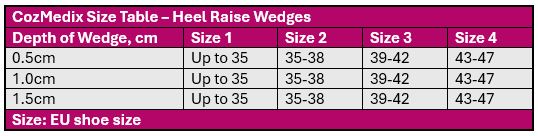
SIZE TABLE
ABOUT THE FEET
Every step begins here! The foundation of the human body for long term physiological resilience. Strong steps today shape how far the body can go tomorrow. The feet are designed to support, absorb and adapt.
Each foot contains 26 bones, 33 joints and over 100 muscles, tendons and ligaments, built for strength and precision. The feet are sensory organs, thousands of nerve endings detect pressure and texture, sending constant feedback to the brain. Balance depends on it, so does coordination. They adjust instantly to uneven ground, sudden shifts, changes in speed and direction. Correction happens even before conscious thought occurs.
From an anatomical point of view, the feet influence posture, alignment, gait and joint health. The arches act as natural springs, they compress and release, absorbing impact and redistributing force with each stride, protecting the knees, hips and the spine above. The sensory receptors in the soles feed the nervous system with balance and coordination.
From a molecular biology point of view, movement activates mechanotransduction, where mechanical pressure converts into cellular signals; increased mitochondrial activity in the muscle cells; improved blood flow and nitric oxide release, supporting vascular health.
CARING FOR YOU FEET
**Healthy feet support mobility ** Mobility supports independence **Independence supports quality of life.
Heel wedges, heel cups, orthotic insoles, heel spurs, arch supports are all very useful in addressing structural alignment issues to help prevent a chain reaction of discomfort in the knees, hips, and lower back.
Exercise and Rehabilitation – Ensuring foot stability and foot health, post-injury or even without an injury requires some degree of training and functional movement patterns for better alignment. Ankle dorsiflexion is essential for an efficient walking gait. Therefore, promoting good ankle dorsiflexion in training can result in improved overall movement quality for injury prevention in daily activities.
Foot Massage – Not just for relaxation, it stimulates mechanoreceptors and activates the parasympathetic nervous system. It can also lower cortisol levels, improve circulation, support lymphatic flow, influence whole body muscle tone through neural pathways.
Right Footwear – The quality of your footwear plays a huge role in maintaining the health and integrity of your feet, whether you are active in sports or just going about your daily activities. Good footwear provides support, cushioning, and proper alignment, which helps prevent issues like foot pain, blisters, or more serious injuries like sprains or stress fractures.
For athletes, the right shoes can enhance performance by offering stability, grip, and shock absorption. For non-athletes, wearing well-fitted shoes reduces the risk of long-term problems like flat feet, plantar fasciitis, or bunions. It’s all about finding that balance – comfort and function can prevent a lot of future foot troubles.
WHAT TO AVOID
Too much standing without movement – This can reduce venous return, increase inflammatory markers and fatigue intrinsic foot muscles. Consider equiping yourself with some support or circulation socks/stockings/tights.
Too much sitting can be just as harmful – This weakens the stabilising muscles of the feet, reduces sensory input to the nervous system and alters collagen structure in the tendons over time.
| Weight | 0.40 kg |
|---|---|
| Dimensions | 10 × 5 × 20 cm |
Be the first to review “Heel Raise Wedges in 3 Depths/Heights: 0.5 cm, 1 cm & 1.5 cm – for Adults”
Related products

Spine, Chest & Abdomen
Elcross Pendulous Lumbosacral Support Belt – 1 left Small 95-105 cm

Spine, Chest & Abdomen

Spine, Chest & Abdomen
CASH300S Spinal Hyperextension Orthosis – Hinged Sternal Pad and Hinged Pubic Pad
Ankle & Foot
Maternity Supports
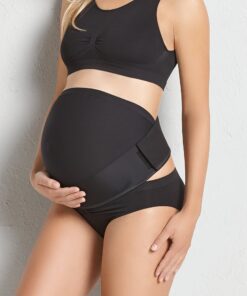
BabyBelt® Maternity Support – For Back Pain Prevention & Tummy Support Throughout Pregnancy

Ankle & Foot


Spine, Chest & Abdomen

Shoulder, Arm & Elbow
Reviews
There are no reviews yet.